Showing posts with label Politics. Show all posts

Monday, 8 September 2014

Will Scotland make history?

By Magdalena Paczocha


On 18 September, voters in Scotland will be asked in a referendum whether they want the nation to become independent from the rest of the United Kingdom. The reason behind the willingness to take Scotland's destiny into Scottish hands was the landslide victory of The Scottish National Party in the 2011 Scottish Parliament election. Independence is a main goal of this party. An agreement was signed on 15 October 2012 by the Prime Minister of the United Kingdom, David Cameron, and the First Minister of Scotland, Alex Salmond, which provides a legal framework for the referendum to be held. The referendum question will say: "Should Scotland be an independent country?"  The principal issues in the referendum are the economic strength of Scotland, defence arrangements, continued relations with the UK, and membership of supranational organisations, particularly the European Union and NATO.


Thursday, 4 July 2013

Britain’s Membership of the EU – The Pros

by Karina Shooter

Photo courtesy of www.bbc.co.uk

Sky News has announced the results of an exclusive survey about Britain’s EU membership. In response to the question: "Do you think that the United Kingdom should remain a member of the European Union?” 51% voted ‘No’, with 49% supporting the ‘Yes’ option.

The results show that there is no clear consensus on people’s views towards EU membership, and if we take into account the fact that the poll will have a margin of error, it really does highlight how result of the referendum vote could go either way. This means that it is more important than ever to discuss the pros and cons of EU membership. I will look at each side of the argument in separate articles. In this article we will look at the advantages of Britain being a member of the EU, in a subsequent article I will explore the disadvantages. 

Perhaps the most obvious advantage of EU membership is the single market. Europe is the world’s largest single market – it is an economic zone larger than that of the USA and Japan combined and it has a total GDP of around £11 trillion. The single market allows Britain to freely trade good and services between countries in the European Union, without tax or regulations. European markets account for half of the UK’s overall trade and foreign investments. It is said that EU countries currently trade twice as much with each other as they would do in the absence of the Single Market. 


Tuesday, 2 July 2013

Hamilton Young Liberals Summit 2013: Progressivism is NOT Dead in Canada

by Eyrie Clark

"The Liberal Party is dead" is a famous saying which many Canadians have heard before. On Sunday the 23rd of June, I attended the Hamilton Young Liberals Summit, hosted at McMaster University by a small group of their devoted students. I'm here to tell you that the Liberal Party, and thus progressivism as a whole, is very much alive and well in Canada and Canadians.

Me with Ivan Luksic (Left), the Liberal candidate for my riding.
The event was attended by a number of Liberal politicians, from incumbent riding presidents to up-and-coming candidates for the Hamilton area, including the Minister of Community and Social Services Ted McMeekin, who decided to spice up his presentation by bursting out into song, something which can only be described as interesting.

After some brief speeches from each of these figures, including some involved students from the university group, the 'official' summit ended and the exciting part began: networking. After the speeches, they opened the floor to the audience to meet with all of the speakers, talk to them personally, and become acquainted. I personally got to meet a few of the politicians, including Ivan Luksic, pictured above with me. He will be running for the position of Member of Provincial Parliament (MPP) for my riding. Without delving into too much detail, an MPP is basically a lesser version of an MP; instead of legislating federally for Canada as a whole, MPPs Legislate and have authority in Ontario only.


Monday, 15 April 2013

'This House' - Political Play by James Graham

by Hannah Gent

This House
The National Theatre Play 'This House' by James Graham


"1974. The UK faces economic crisis and a hung parliament. In a culture hostile to cooperation, it’s a period when votes are won or lost by one, when there are fist fights in the bars and when sick MPs are carried through the lobby to register their vote"

'This House' is set between 1974 and 1979, showing the political climate of the Harold Wilson and James Callaghan governments. The Labour Party started out as a minority government in 1974  and only had the majority by a few votes in the second election of that year. Therefore, every vote counted for the Labour Party as they had to fight to pass legislation. In order to do this they had to win over as many of the ‘odds and sods’ as possible. These 'odds and sods' were the MPs from minority parties such as the liberals. With an extremely slim majority the Labour Party need every other vote possible as the vote can be won or lost by just one.


Tuesday, 19 February 2013

And so it Spins

by Eyrie Clark

revolving door, politicians, lobbyists, corporations
Thanks to Matt Wuerker and the Cartoonist Group.
   When talking about politics, politicians, and especially political corruption, you often hear the term 'Revolving Door' come up. 'They are just a part of the revolving door,' or 'It's all just one big revolving door'. But what does that even mean?

   Well, I ask you to look to the illustration to your right in this article and skim through it. It is a vast simplification of the process, but nonetheless, it is still incredibly accurate. In this article, we will be picking through the picture, as well as examining a few politicians as examples.

   But first, like I started this article: what is the 'Revolving door'? Basically, the theory of it is that business men who decide they are not making enough money go into politics. You will notice step one; 'Take a bunch of corporate cash. Buy a seat in congress!' This step is accurate because, time and time again, it has been shown that the campaigns that spend tons of money tend to win elections. Think of how Mitt Romney won the Republican Nomination. Not because he was better policy-wise than anyone else, but he was better-funded. But why? Politicians may be paid an OK amount if you were an average citizen, but it comes with the extra cost of having to maintain two residences: one in the nation's capital, and one somewhere in their constituency.


Tuesday, 4 December 2012

Academies: The Dangerous Schools

by James Wand

michael gove, secretary of state for education, education secretary, academies
Michael Gove, the UK's Secretary of State for Education
Image courtesy of The Times
After disappointing results for thousands of students in their GCSE exams this summer, those entering secondary schools for the first time this week will be going in with more trepidation than ever before. It’s hard not to feel that the class of 2012 have been hard done by as they bear the brunt of Michael Gove’s radical reforms. Radical reforms that have resulted in schools changing from local education authority lead establishments to academies and free schools, moving away from the safety net that is local government and towards the dangerous and volatile world that is the educational free-market.


Saturday, 1 September 2012

Communism vs. Capitalism

by Charlotte Wright

Communism and capitalism provide two very different ways of life. Is one better than the other?


communism vs capitalism, communism, capitalism, economics for teens, economics for teenagers
An interesting opinion!

Wednesday, 1 August 2012

China's One Child Policy: a Good Idea?

by Shireen Avasthi

china, one child policyHow big is your family? How many siblings do you have? If you'd been born in China, you wouldn't have any: you would be an only child.

Is that fair? should a government be allowed to decide how many children a couple have? Whether or not a child has brothers and sisters to play with. Should anyone have the right to decide if a child has an enjoyable childhood?

If you have siblings, think about all the fun you've had together. Of course you have your arguments, but above all, you genuinely have a good time together.

I'm sure children with no siblings also have a fun-filled childhood; all the extra attention from parents must be great, but imaging doing all those exciting things with someone closer to your age to share them with. Wouldn't that be great?

I'm not denying that China's one child policy is a sensible way to try and control their immense population problem: it is. But are the rights families and children are required to give up in order to enforce this too heavy a price to pay?

Saturday, 14 July 2012

A Guide to the Syrian Uprising

by Hannah Gent


http://www.bbc.co.uk/news/world-middle-east-13855203

This is a very simplistic guide to what is happening currently in Syria. The 'Syria Crisis' started with protests earlier in 2011 when protesters asked for the release of political prisoners. The protests have then continued and the violence has escalated. The overall aim of the protesters was to gain democracy and 'greater freedom'. The BBC news link shows what the protesters wanted in more detail and how President Assad has responded.


Syria is an important country in the Middle-East. This means that the chaos here could cause problems in near-by countries such as Israel and Lebanon. Furthermore, even without the violence, Syria still needs a large amount of time to recover from the economic impact of the instability of the country. One of the main reasons why Syria is facing economic problems is because of the lack of tourists and therefore business. Moreover, places like Lebanon and Jordan have had to take in thousands of Syrian refugees. Jordan, which is already struggling against a large national deficit and high unemployment rates, is also facing a decline in the number of tourists. This means that Syria is inflicting these economic stresses onto other neighbouring countries which may cause unrest between countries in the Middle East and lead to further violence in the near future.


What do you think will happen with the current situation in Syria?

syria, middle east, politics

Friday, 13 July 2012

The Social Contract: Part 2

by Viva Avasthi

bees, the fable of the bees, economics for teens, economics for teenagers
Is the ideal society reflected in The Fable of the Bees?
Niall Ferguson argued in the first of this year's Reith Lectures that the social contract (which I explained in my previous article) needs to be restored between the generations. I agree with him to an extent, because it does appear to be the case that governments often don't work in the interest of improving conditions for both the present and the future generations, but to improve their chances of collecting votes. This leads to a vicious circle in one sense, because the government is forced to provide people with what they demand rather than to do what is ideally required to tackle a particular problem.


Tuesday, 10 July 2012

The Social Contract: Part 1

by Viva Avasthi

“Society is a contract… the state is a partnership not only between those who are living, but between those who are living, those who are dead, and those who are yet to be born.” (Edmund Burke - 18th Century political theorist and philosopher)


people, society, culture, economics for teens, economics for teenagers
Edmund Burke was essentially suggesting that the well-being of the nation and all its citizens is of greater importance than the individual. In a sense, this is very similar to the quote "no man is his own island" in the way that the idea of everybody being deeply interrelated is a prominent feature of both quotes. But how many of today's governments are actually adhering to the 'contract' that everybody seems to have unwittingly signed? This intriguing idea was elaborated upon by the economic historian Prof. Niall Ferguson in the first of this year's  BBC Reith Lectures. In this first of a series of four lectures, Niall Ferguson argued the case that "today we've had a breach of [the contract]." 

On Friday, I will be explaining how Niall Ferguson defended his point of view and I will be giving a few counter-arguments both for the sake of debate and to provide you as readers with a relatively balanced perspective. However, before we engage in some serious debating on Friday (yay!), here's a chance for you to share your initial views on the subject.

 Do you believe modern governments are in breach of this 'contract'? Do you feel that governments need to be more open in terms of revealing their decision-making and so on to the public? Comment, comment, comment!

Click here to read the follow-on article.

Sunday, 20 May 2012

So What Next For The Euro?

by Hannah Gent

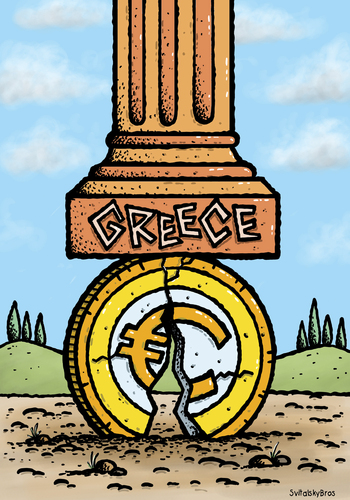
In my last article I described how the desire of European nations after World War II to prevent future conflicts led to increasing co-operation and integration with the ultimate formation of the European Union and the single European currency.  I looked at how, despite this having significant benefits, the ‘one size fits all’ policy was risky, tying nations at different stages of economic cycles to a fixed interest rate that could either prevent growth or over-stimulate economies.  The financial crisis of the last four years has exposed the weaknesses in this system and the next three months are going to be very interesting indeed.  So what is going to happen next?

greece, euro, eurozone crisis, world, europe, economy

Thursday, 10 May 2012

Obama on Same-Sex Marriage

barack obama, gay marriage, same-sex marriage, gay rights, obama, economics for teens, economics for teenagers, teenage economist, teen economistby Clemency Flitter

It has been a highly contentious issue in American politics for some years now, with many politicians using clever words and neat quotes to scurry around the topic but now President Obama has spoken outright that same-sex marriage should be legalised in America. Obama has himself seemingly been avoiding making a clear statement for some time; instead describing himself as “evolving” on the issue. This turn of events is sure to bring hope to supporters of same-sex marriage across America and in the wider world. However, this comes just a day after the state of North Caroline voted to ban same-sex marriages and similar amendments have taken place in roughly 30 other states, so is the issue any closer to being solved?

Sunday, 6 May 2012

The Euro Crisis - How Did We Get To Where We Are?

by Hannah Gent


european union, EU, flag, economics for teens, economics for teenagersEuropean Union, EU, flag, economics for teens, economics for teenagers


The world is in the middle of very turbulent financial times, particularly in Europe. In the first of two articles I will explain how the current situation has arisen.

In 1958, six European countries decided to join together for their mutual benefit. It was soon after the Second World War and it was thought that future conflicts could be avoided by greater cooperation. This was the beginning of the European Union (EU) although it was not known by this name until 1993. There are now 27 member states mainly within Europe. 

Saturday, 5 May 2012

The Unexpected City That Changed The World

by Viva Avasthi
birmingham bull, birmingham city centre, bullring


Do you live in a democracy? Are you American? Are you a female? Are you of African or Caribbean origin? Do you live in a country that manufactures goods?

If you can say yes to any one of those seemingly random questions, then you've almost certainly been massively affected by Birmingham, a British city that you might never have heard of.


Friday, 27 April 2012

From Pottery Shards To Phone Votes: Where Does The UK Fit In?

by Clemency Flitter

women's rights, campaigners, votes, economics for teens, economics for teenagers, teenage economist, teen economist
Two Campaigners

I like to think many people who live and work in the UK are very proud of the democracy we share in this country. Every five years we all get to vote and choose a party which will go on to represent us and make the decisions on behalf of the population. Many have striven and many have died for this right to everybody getting a free and secret vote, with first the push to get all classes an equal vote and then the protests and hunger strikes of Votes for Women. It’s been a pretty rough ride getting to where we are now, and I would say it has been worth it, for there is certainly more equality in the way the government is run now than ever before. But is it still truly a democracy?
 

Wednesday, 4 April 2012

Sweatshops: a Curse or a Boon?

by Viva Avasthi

Sweatshops have been branded as places where the poor in developing countries are forced to work under horrible conditions for massive multinational companies such as Nike, for example. But is this really the case? Are there benefits to so-called 'sweat shops'?


Contents of Investigation:

  1. Introduction
  2. The problems with sweatshops
  3. An alternative approach to the issues surrounding sweatshops
  4. Conclusion
sweatshop, sweatshops, economics for teens, economics for teenagers, teenage economist, teen economist