Showing posts with label Opinions. Show all posts

Thursday, 7 July 2016

Was the Brexit referendum a good reflection of "the will of the people"? Possibly not.

by Viva Avasthi

There's something both Leave and Remain supporters have missed. Discussing it matters for the short and long run of this country. 


Two weeks on, there is still furious debate among and between Leave and Remain supporters. Yet there appears to be consensus on one thing: that the referendum result was "the will of the people" and therefore "must be respected". Leave supporters are brandishing this as their infallible weapon against attempts by the Remain side to prevent or soften Brexit. Remain supporters, broadly conceding, are limiting their actions to lamenting the lies told by the Leave campaign and attempting to find (varying degrees of) obscure methods to prevent our leaving the EU. 

Both sides miss the point. 

There is a case for the referendum not being a good reflection of "the will of the people". The reasons come under two umbrellas. First, the problems with the information provided prior to the referendum; second, the problems with the structure of the referendum itself.

Missing: democracy featuring an informed electorate

For democracy to function well as a reflection of "the will of the people", it is essential that voters are well-informed. The first thing that the electorate should have been informed of was where to turn for an impartial and - crucially - thorough and accessible analysis. This did not happen. Instead, they were offered lies from the Leave campaign, list after list of influential figures backing the Remain campaign, and an extremely poor quality of public debate. Not a mix conducive to effective democracy.

The reader might justifiably wonder whether such impartial sources even existed. In fact, they included: The UK in a Changing Europe, a website based at King's College London and funded by the Economic and Social Research Council; fullfact.org, a non-partisan fact-checking charity; and, produced by the libraries of the House of Commons and House of Lords, this impartial analysis.

There is also some ground for criticising the BBC's role. In attempting to fulfill their remit of being non-partisan they gave roughly equal air-time to both sides on each aspect of the debate (the economy, immigration et al.). In reality though, if we take, say, the analysis on the economy, the sheer volume and quality of argument was on the Remain side. The BBC's coverage, therefore, may well have harmfully distorted the public's views by diluting some critical arguments.

All this matters immensely. Those who condemn Leave voters as "stupid" or "racist" do not appreciate how little information was actually provided to people to help them vote in an informed matter. They do not appreciate how little time people had to uncover and then analyse the intricacies of the UK's relationship with the EU once they'd come home from each hard day's work. Is it really a surprise, then, that large numbers of people brought sheer emotion rather than reason to the ballot box? Had people been aware of the facts, they might not have confused what lies within the remit of the EU and what does not; which problems were caused by our being in the EU and which were not; what our position might be outside of the EU and what it will not.

Then there is the issue of so-called "apathy" among young people. Rather than laziness, the very low turnout among 18-24 year olds was more likely a result of the paralysis stemming from simply not knowing which was the "right" side to vote for. Again, a sign of an uniformed electorate. That paralysis was possibly exaggerated by the fear created by the knowledge that the outcome would affect them for the longest of any of the voting categories. A low turnout necessarily means that such a referendum is only a limited reflection of the "will of the people".

Second, the electorate should have explicitly been made aware or reminded of the crucial difference between voting in a general election and voting in a referendum. This would have reduced the numbers of people voting Leave simply because they did not think we actually would (protest voting) and increased voter turnout - making the referendum a far better reflection of "the will of the people" than at present. Effective democracy depends on the electorate knowing how the system works. It is not acceptable to simply assume that the electorate surely must.

When is a referendum any good?

There's another angle. Even if we ignore everything said above, there are further legitimate reasons why we might not accept the referendum result as being a good reflection of "the will of the people".

First, the Condorcet paradox applies in the case of this referendum. In his fantastic (and accessible) article written prior to the referendum, Jonathan Portes outlines what the Paradox is and how it is relevant to the British case.

The introduction to his article reads:

The problem with referenda, writes Jonathan Portes – and especially this one – is that they often present binary choices which do not necessarily reflect voters’ true preferences. This can force politicians to implement policies that are at odds with the will of the majority. He uses the Condorcet paradox to illuminate the difficulty, and asks what it mean for Parliament after the referendum.

Second, we must not forget that the choice of referendum-winning majority was an arbitrary one. Cameron decided that a "win" for either side would require gathering over 50% of the vote. Other countries choose a best-of-three-referendums system, or a two-thirds majority system, for example. Was our choice necessarily the best one? As the Economist puts it:

[...] what about the 16,141,241 voters who endorsed remaining in the EU? The 52% of those aged 35-44? The 56% of Northern Irish voters? The 60% of Londoners? The 62% of Scots? The 62% of those aged 25-34? The 67% of Asian voters? The 73% of 18-24 year-olds? The majority of Britons in full- and part-time work who voted to Remain? And the large minorities of most other groups, as well? Not to mention the 1.1m Leave voters who, one poll by Survation suggests, now wish they had voted differently. Or the millions of Britons abroad who could not vote in Britain. Or the roughly 3m residents of Britain—who work, pay taxes and contribute to society like everyone else—who by dint of their foreign EU passports may soon be pawns in Ms May’s negotiation.

The long and short of it

The are two things to take from this.

If MPs have the chance to vote on triggering Article 50, as is likely, they have a difficult decision to make. Should they vote to Remain, which they overwhelmingly believe to be right, based on their expertise? Or should they honour "the will of the people" and vote to Leave, despite personally believing the opposite outcome to be best for the people they represent? If the referendum does not really reflect "the will of the people" this decision is no longer so difficult. Britain is a representative democracy and MPs should follow their professional judgement - as they have been elected to do.

In the words of Burke (1774):

To deliver an opinion, is the right of all men; that of constituents is a weighty and respectable opinion, which a representative ought always to rejoice to hear; and which he ought always most seriously to consider. But authoritative instructions; mandates issued, which the member is bound blindly and implicitly to obey, to vote, and to argue for, though contrary to the clearest conviction of his judgment and conscience,--these are things utterly unknown to the laws of this land, and which arise from a fundamental mistake of the whole order and tenor of our constitution. 

The second thing to take away is this: we as a society need to collectively reconsider how democracy can work best for us. We need to understand that there are different forms of democracy and that each of these forms is more or less appropriate depending on the context. We need to actively consider how to ensure that the electorate is provided with the vital information it needs to make decisions, and that young people aren't left confused or disinterested. In the context of an increasingly globalised world with the rise of technology in forming and shaping debate and opinion, we are likely to find that, upon observation, our democracy cannot and should not continue in its present form.


Tuesday, 7 January 2014

Some Thoughts on the Minimum Wage

By Loren Chue
Her author profile can be found below this article.


Imagine strolling in your local shopping center or mall. Your stomach growls, and try as you might to suppress the hunger pangs, your stomach chides you for not feeding it and satiating its need for food. Without further ado, you stroll into the nearest Subway, eager to purchase a five-dollar footlong. As you stand waiting, you watch a young lady prepare your lightly toasted sandwich. She is about high school age, and you think, She really should be taking a break or studying right now. The young lady hands you the sandwich and you order an extra bowl of steaming minestrone. Heading towards the cashier, this time a middle-aged man, adds up the cost and says “$7.50 please.” You hand him your credit card to swipe, and he hands you the receipt, places your food in the bag, adds a few extra napkins, a fork and a spoon, and off you go, ready to enjoy a fresh, hot meal.
 
In the Journal of Economic Issues, the liberal economist Robert Prasch defends the minimum wage. These, he writes, are the three main benefits of putting a price floor on labor: “First, it increases the level of effective demand; second, it provides an impetus for rapid technical change; and third, it equalizes bargaining power in labor markets.”
 
Here’s the breakdown:
 
Prasch asserts the minimum wage increases the level of effective demand by transferring the purchasing power over from “profits, perks and overheads to those who earn low wages.” He also writes that transferring purchasing power will “increase domestic spending.”
 

Tuesday, 3 December 2013

“Walmart is good for you!” Oh, really?

By Stephanie Canavan
Her author profile can be found below this article.


With the holidays approaching, one can hardly turn on the TV without being bombarded by commercials shouting that their store has the best deals and lowest prices. Perhaps one of the loudest culprits of these holiday season adds is Walmart. Long known for its low-price guarantees, Walmart is a front runner in boasting its benefits toward your microeconomic holiday family budgets. But from a macroeconomic perspective, Walmart can have less than positive repercussions for the economy as a whole. I recently read an economically faulty article, written by Tom Van Ripper, entitled “Walmart is good for you” which presented an alternative opinion, supported with scanty facts and jumpy assumptions.

Tom Van Ripper began his argument on a foundation of sand, basing virtually his entire debate on the misguided conclusion of a recent study which stated “between 1985 and 2003, personal income, overall employment and retail employment grew faster in counties with a Walmart than in those without one.” The lousy economist incorrectly placed assumptions that because of this finding, Walmart must be the sole beneficiary force causing these positive economic happenings. In fact, there could be a myriad of other factors that caused this economic growth, such as higher investments in education or monetary policies. Van Rippers article continues with more misused statistical proof by quoting a statement from the Federal Reserve “Nearly 90% of the U.S. population lives within 15 miles of a Walmart store, and two-thirds of all retailers are located within five miles of one, the Fed’s report says.” Simply because the Federal Reserve released this statement does not mean it can be used as evidence towards the economic benefits of Walmart. Conversely, this statement simply shows the vast spread of the Walmart enterprise and how greatly such a behemoth could affect the US economy.

Sunday, 17 November 2013

How might the US Government Boost the Economy?

By Brenna Fisher
Her author profile can be found below this article.


Credit to CBS News

In this controversial age where Democrats and Republicans are at each other’s throats daily, debating the politics and economic problems that face America today, it seems like any simple question will receive a long, complex answer. Unsurprisingly, as the United States enters deeper into a economic stagnation, fueling economic prosperity is on everyone’s minds. But just how simple is the answer? Certainly, there are many different opinions, and there is no “easy” button to press and fix the financial turmoil. However, one tactic could solve a majority of the problems, though it wouldn’t be the popular decision.

Wednesday, 25 September 2013

'Gun Control' - Does it work?

by Eyrie Clark

11 dead. 10 dead. 26 dead. Every year, over 250 mass-shootings take place in the United States, making an average of almost once per day.

In the wake of so many mass-shootings: Fort Hood, the Aurora theater, Sandy Hook Elementary School, and most recently the shooting at the navy yard in Washington, D.C., and finally, the shooting of 13 people in a Chicago basketball court, which included a three-year-old child among the victims, many people not only in the United States, but around the world, are having a serious debate about the merits - or lack thereof - of gun control.
Credit to The Guardian

Many people believe there is no connection between gun control and the rate of violence in a country. For instance, Republican Representative John McCain believes that there is no connection between guns and violence at all. He, along with many other conservatives, persistently speaks out against gun-control laws, attempting to block almost all progress. So let's start out by having some fun and tearing his statement to pieces.

Wednesday, 31 July 2013

Is Latin really making a comeback?

by Viva Avasthi


Ancient Rome

Despite The Economist's conviction that Latin is making a comeback, as described in their article from a couple of days ago, I beg to differ. In fact, I believe that the question is not, "Why is Latin making a comeback?" but rather, "Is Latin really making a comeback?"

I'm afraid the answer is, "Not really, no."

Although it would be brilliant if Latin really were making a comeback, The Economist's argument that Latin is becoming more popular can be refuted in two parts: by observing the ancient language's popularity in young people and by analysing just how popular the Latin-based services the newspaper refers to are. I'll also try to attempt to use ideas from behavioural economics to explain why Latin is not making a comeback any time soon.

Monday, 15 April 2013

'This House' - Political Play by James Graham

by Hannah Gent

This House
The National Theatre Play 'This House' by James Graham


"1974. The UK faces economic crisis and a hung parliament. In a culture hostile to cooperation, it’s a period when votes are won or lost by one, when there are fist fights in the bars and when sick MPs are carried through the lobby to register their vote"

'This House' is set between 1974 and 1979, showing the political climate of the Harold Wilson and James Callaghan governments. The Labour Party started out as a minority government in 1974  and only had the majority by a few votes in the second election of that year. Therefore, every vote counted for the Labour Party as they had to fight to pass legislation. In order to do this they had to win over as many of the ‘odds and sods’ as possible. These 'odds and sods' were the MPs from minority parties such as the liberals. With an extremely slim majority the Labour Party need every other vote possible as the vote can be won or lost by just one.


Wednesday, 6 March 2013

Are Human Rights Under Fire...Literally?

by Eyrie Clark

http://static.guim.co.uk/sys-images/Guardian/Pix/pictures/2009/8/7/1249632608760/A-Reaper-drone-as-used-by-001.jpg
A Reaper Drone
Credit to The Guardian

A 16-year-old boy was murdered. He never did anything wrong. He never even saw his death coming. The crime was his father's, and he was executed because of association even after his father had been killed. Do you think this is wrong? It's already happened.

As technology progresses, humans find more and more ways to use such technology to satisfy their agenda - which usually means someone has to die.

And, sadly, that is the case now, as the public has recently found out about a secret government program, that was apparently so top-secret that former White House Press Secretary Gibbs was ordered to deny its existence.

This alone is obviously VERY alarming. Any program the government tries so hard to keep a secret obviously spells bad news.What is so bad that they're afraid of their own citizens knowing of its existence?

Well, that program is the 'Drone' program. It is a billion-dollar program to create and pilot unmanned, armed drones to use as scouts and, when needed, the middleman who carries out the sentence for the executioner. Someone in Florida could press a button and and blow up a wedding in the middle-east, all in real time.


Sunday, 20 January 2013

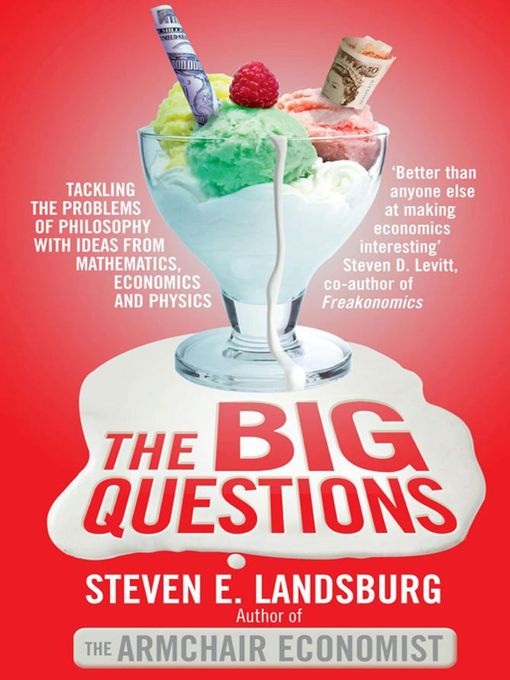
The Big Questions: Book Review

by Viva Avasthi
                                                                       Rating out of 5: ★★★


I don’t know how many of the readers of this blog are familiar with the writings of Steven E. Landsburg, a professor of economics at the University of Rochester in Rochester, New York. For me, this was the first time I’d read any of his books despite the fact that another of his books, entitled ‘The Armchair Economist’, is far more popular.

The book has been written to fulfil the purpose of “tackling the problems of philosophy with ideas from mathematics, economics and physics”, which sounds brilliant, but it’s arguable as to whether the author actually manages to achieve this purpose as well as could be expected from a best-selling author.

In his introduction to the book, Landsburg writes:

“In this book, I’ll tell you what I believe about the nature of reality, the basis of knowledge, and the foundations of ethics. I’m not sure any of my beliefs are right, but I’ll explain why I think they’re plausible – and more likely to be right than any other beliefs. (Though of course I might eventually be convinced otherwise by new arguments.)” 

Saturday, 8 December 2012

Cuts cost Growth

by James Wand


This week's Autumn Statement was possibly the bleakest outlook on the economy for more than sixty years. The economy is in an appalling state of stagnation and collapse, the foundations are failing and plans to secure its recovery are faltering at every turn. George Osborne has failed to heed the warnings from the IMF and the World Bank, and is placing ideology and addiction to public sector cuts before the necessity of supporting the weakest and most vulnerable in our society. This Urgent Statement addresses the horrifying Autumn Statement.

As we further move towards winter we must face the reality that what lies immediately ahead will be the twenty-first century version of the winter of discontent. Osborne, addicted to cuts, deeper cuts, and even deeper cuts admitted today that Plan A had failed and austerity would last until 2018 at the earliest. Average growth forecasts from the Office for Budget Responsibility, the IMF, EU Commission and Credit rating agencies have even suggested that such claims are unrealistic; with comparisons to the March Budget suggesting that confidence even within the inner circle of the Treasury has all but disappeared. We face a decade of decay and austerity – this is no less than a national disaster and one that we must address quickly.

Tuesday, 4 December 2012

Academies: The Dangerous Schools

by James Wand

michael gove, secretary of state for education, education secretary, academies
Michael Gove, the UK's Secretary of State for Education
Image courtesy of The Times
After disappointing results for thousands of students in their GCSE exams this summer, those entering secondary schools for the first time this week will be going in with more trepidation than ever before. It’s hard not to feel that the class of 2012 have been hard done by as they bear the brunt of Michael Gove’s radical reforms. Radical reforms that have resulted in schools changing from local education authority lead establishments to academies and free schools, moving away from the safety net that is local government and towards the dangerous and volatile world that is the educational free-market.


Sunday, 7 October 2012

Some Thoughts On...'Soaps'

by Karen Birnie


soaps, soap opera, television, economics for teens, economics for teenagers, teenage economist, teen economist
What is it about soap operas
 that makes them so addictive to the masses?
For the sake of this argument, let's say that you are taking the bus home. In front of you are two women, who are talking quite loudly, and you happen to hear snippets of their conversation. 'Did you see 'Enders last night?' 'Oh yes,' comes the reply, 'did you see what Stacey did? I can't believe she'd dare to...' and so the conversation falls prey to the winding plot of none other than the soap opera. I know that I find myself in similar situations frequently, and for this reason it seems the 'soap' is an integral part of society.

The soap opera - a staple, it seems, in the TV timetables, where millions sit down and spend the next thirty minutes transfixed, immersed in the dramas of Coronation Street or the Queen Vic. Where does the appeal lie? Few genres of television show have such a following. One reason could be that the protagonists are 'real life' people, that the every day working person can relate to. They are not extraordinarily clever, rich, or beautiful, they are not perfect; for the most part they are like us. This makes them easy to relate to and empathise with, and despite not existing outside of the show, the characters compel us to learn their story.

Tuesday, 7 August 2012

Fame: A Secret Formula?

by Karen Birnie

Is there something that all famous people have in common? Is there some special thing that some people have which guarantees recognition? Or is it just plain hard work?

There's no doubt that to make it into the public eye in any field, one must be prepared to work extremely hard. Actors, singers, even scientists; to be renowned, your work must be of a supreme quality.


But surely there's a secret formula that leads to success, a secret ingredient in the mix of skill and hard work. Some people just seem to attract the limelight. What is it about these people? Do they make an extra effort, or are they born with it?


                             Audrey Hepburn, the highly successful actress...what was her secret?

Sunday, 29 July 2012

Gender Equality: Fact or Fantasy?

we can do it, gender equality, feminismby Shireen Avasthi


In the Western world, many people are under the illusion that gender inequality is alive and thriving in the East, and in the West everyone is equal. Despite this being a common opinion, it is far from the truth. Admittedly, the East has a lot of problems where gender inequality is concerned, but the West definitely doesn't have a clean slate either.

So let's start with the East. Here are 10 of the most shocking examples of gender inequality that exist there:


Wednesday, 25 July 2012

Ageing: Why Are People Scared of It?

by Shireen Avasthi
old woman, fear of ageing
Why do so many of us have a fear of ageing?

Having a phobia of ageing is nothing to be embarrassed of - lots of people are in the same situation. The question is: why do so many of us have a fear of ageing? 

What do you value most about youth? Is it beauty, intelligence, freedom, just having a good time and a laugh, or is it something else? Whatever it may be, chances are that there are multiple stereotypes pinned to it. More likely than not, one of these stereotypes is that you will be robbed of this quality as you grow older.

Sunday, 22 July 2012

Can Murder be Justified?

by Salma Rana
police line, murder, economics for teens, economics for teenagers, teenage economist, teen economist
This question may seem rather straightforward and you may initially find yourself leaning towards ‘No, murder cannot be justified’ because all in all, it is not acceptable to take away someone else’s chance at life. Right?  However, when you look at the bigger picture you find that it is more complicated than that because of the various degrees to murder and really, what is classified as murder and what makes it justified? 


Thursday, 19 July 2012

Older Women in the Media

women, tv, female presenters, bbc
Luck of the draw or are older women not welcome on TV?
by Clemency Flitter

Female equality is something that many people would like to feel has finally been put to bed and women are now being seen on a par with men in most areas. However, it seems to me that the media has so far been a little slow to take up this ideal. Recently the BBC has been under fire over an ageism scandal after a former Countryfile presenter, Miriam O’Reilly, won an age discrimination case against the BBC after being dropped from presenting the TV show. While I agree that this may have been a clear case of age discrimination I can’t help but wonder if the same would have happened if Miriam was a man.


Tuesday, 17 July 2012

10 Impacts of the Olympics on the UK

by Viva Avasthi
olympics mascot. olympics, mascot, wenlock, mandeville, economics for teens, economics for teenagers

With only ten days remaining until the opening ceremony for the London Olympics commences, here are ten ways that the Olympics have affected (or will affect) the UK.


Friday, 13 July 2012

The Social Contract: Part 2

by Viva Avasthi

bees, the fable of the bees, economics for teens, economics for teenagers
Is the ideal society reflected in The Fable of the Bees?
Niall Ferguson argued in the first of this year's Reith Lectures that the social contract (which I explained in my previous article) needs to be restored between the generations. I agree with him to an extent, because it does appear to be the case that governments often don't work in the interest of improving conditions for both the present and the future generations, but to improve their chances of collecting votes. This leads to a vicious circle in one sense, because the government is forced to provide people with what they demand rather than to do what is ideally required to tackle a particular problem.


Thursday, 12 July 2012

First World Problems And Some Solutions


government, depression
Are "first world problems" unworthy?
by Clemency Flitter


I’m sure that I can’t be the only one whose heart sinks whenever they hear the now over-used phrase, “first world problems”. It seems that in these times of globalisation, when everyone knows how people in other countries live, it’s almost impossible to have a problem worthy of being thought of as anything more than a “first world problem”. 


I don't deny that conditions in third world countries are more than appalling and, of course, worthy of people’s consideration and help. But just because there are reams of people who could be considered to be having a much worse life than our own, has the bar somehow been raised whereby our problems are only worth true sympathy if they involve starvation and death?

At first I thought that this surely couldn't be the case. After all, there are often times when I can’t help but sigh when I hear someone start up a long rant about a favourite top having been lost in the wash. It seems to me that "first world" people in general seem to give themselves a bit of a tough ride with their true problems and true worries.