Thursday, 24 January 2013

Just Google It...

by Karina Shooter


How Google searches can predict economic indicators and give us an accurate picture of today’s economy

Google, searches, economic data, economics
Up until recently, Central banks have only used official data when calculating and predicting economic indicators such as unemployment, housing starts and consumer confidence.  However official data is published a significant time after it has been collected (usually at least a month) which means that bankers found it difficult to calculate up-to-date predictions. How could bankers determine the present and future state of the economy, using figures that were only a reflection of the past? As Brynjolfsson, a professor at MIT, said “When central bankers were looking at traditional data, they were essentially looking out the rear-view mirror.”

However research has emerged which suggests that by analysing Google searches, we can obtain a clear picture of today’s economy as well as being able to accurately predict future cycles. For example, when trying to estimate unemployment figures, researchers found that by calculating the proportion of Google searches which contained key words such as “JSA” (short for jobseeker’s allowance), “jobs” and even “solitaire”, they could accurately calculate figures that almost exactly matched the official data when it was published weeks later.


Sunday, 20 January 2013

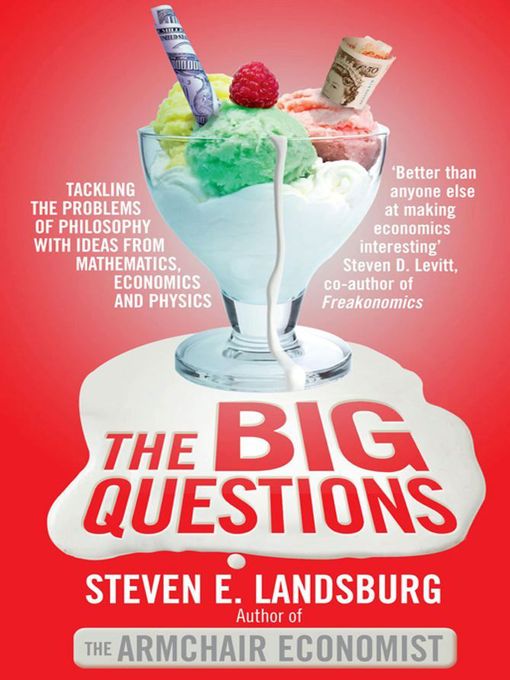
The Big Questions: Book Review

by Viva Avasthi
                                                                       Rating out of 5: ★★★


I don’t know how many of the readers of this blog are familiar with the writings of Steven E. Landsburg, a professor of economics at the University of Rochester in Rochester, New York. For me, this was the first time I’d read any of his books despite the fact that another of his books, entitled ‘The Armchair Economist’, is far more popular.

The book has been written to fulfil the purpose of “tackling the problems of philosophy with ideas from mathematics, economics and physics”, which sounds brilliant, but it’s arguable as to whether the author actually manages to achieve this purpose as well as could be expected from a best-selling author.

In his introduction to the book, Landsburg writes:

“In this book, I’ll tell you what I believe about the nature of reality, the basis of knowledge, and the foundations of ethics. I’m not sure any of my beliefs are right, but I’ll explain why I think they’re plausible – and more likely to be right than any other beliefs. (Though of course I might eventually be convinced otherwise by new arguments.)” 

Sunday, 30 December 2012

2012 in the City

by Viva Avasthi

Now that we've (successfully) come to the end of another year (because the world hasn't ended), here's a useful overview of the major political and economic occurrences this year from The Week magazine.

Note that if you open the images in new tabs, you'll be able to read the text far more clearly.


Wednesday, 12 December 2012

Demand and Supply Analysis to solve Parking Problems?

by Karina Shooter

In many crowded cities across the world it is common for frustrated drivers to be unable to find a parking space. In fact, it has been estimated that about one third of congestion in cites is caused because drivers circle the streets in order to find an empty parking spot. This not only inconveniences the drivers themselves, but also has a big social cost - cars circling the streets produce extra fumes and pollution (which otherwise would not have been produced had a parking space been available) and it also increases the risk of accidents - a driver looking for a parking space is much less likely to notice an oncoming pedestrian or cyclist. 

In order to combat this problem, San Francisco has introduced a high-tech parking system called SFpark. The aim is to keep one parking space free per block at any one time, by using supply and demand analysis. 

Since sensors have been installed into parking bays around the city, which register when the parking bay is being used, drivers now pay flexible parking rates in accordance to how busy the parking spaces on that block are. The rates are reviewed every two months. If a block of parking spaces is particularly popular and rarely has a free parking space, rates for that block can be increased by 25 cents, whereas if a block frequently has free parking spaces, prices can be decreased by up to 50 cents in order to increase demand and reduce the number of available parking spaces until only one per block remains. 

SFpark has also made it easier for people to pay for parking, by introducing credit card machines in parking meters. In addition, people are able to check online, via text or on their smartphones whether the area which they would like to park has any available parking spaces - this may encourage people travelling to busy areas to use public transport. 

Although it is too early to conclude whether the new parking system has been effective, preliminary data suggests that three-quarters of the blocks have either hit their targets or moved closer to the overall goal of one available parking space per block. In addition, the scheme seems to be more successful on weekdays than weekends. 

Saturday, 8 December 2012

Cuts cost Growth

by James Wand


This week's Autumn Statement was possibly the bleakest outlook on the economy for more than sixty years. The economy is in an appalling state of stagnation and collapse, the foundations are failing and plans to secure its recovery are faltering at every turn. George Osborne has failed to heed the warnings from the IMF and the World Bank, and is placing ideology and addiction to public sector cuts before the necessity of supporting the weakest and most vulnerable in our society. This Urgent Statement addresses the horrifying Autumn Statement.

As we further move towards winter we must face the reality that what lies immediately ahead will be the twenty-first century version of the winter of discontent. Osborne, addicted to cuts, deeper cuts, and even deeper cuts admitted today that Plan A had failed and austerity would last until 2018 at the earliest. Average growth forecasts from the Office for Budget Responsibility, the IMF, EU Commission and Credit rating agencies have even suggested that such claims are unrealistic; with comparisons to the March Budget suggesting that confidence even within the inner circle of the Treasury has all but disappeared. We face a decade of decay and austerity – this is no less than a national disaster and one that we must address quickly.

Friday, 7 December 2012

Stem Cell Research: Life-Saving or Cold-Blooded Murder?

by Sparshita Dey

^Embryonic stem cells
Stem cell research may be the next scientific breakthrough. Scientists think that if we can discover how specialised cells turn off/on certain genes to give them particular functions and characteristics, we can start "growing" specific cells using stem cells from a person's body. These can be used to cure genetic diseases (which cannot be cured at the moment and can result in a lifetime of pain and discomfort, including early deaths) as well as other diseases that are not yet curable e.g. diabetes and paralysis. So surely using stem cells should get the go-ahead straight away? Then why do so many people oppose it? 

What is Stem Cell Research and what are Stem Cells?

Stem cell research is to do with the research of undifferentiated cells (i.e. cells with the ability to differentiate/specialise into any type of cell with any type of function in the body depending on where it is needed/ used). In plants, specialised cells can become unspecialised again (like stem cells) and then re-differentiate if needed. However, in animals, like humans, the stem cells differentiate very early on in the development of the organism (from just after a zygote is formed – i.e. in the embryonic stage) and this change is permanent.

Tuesday, 4 December 2012

Academies: The Dangerous Schools

by James Wand

michael gove, secretary of state for education, education secretary, academies
Michael Gove, the UK's Secretary of State for Education
Image courtesy of The Times
After disappointing results for thousands of students in their GCSE exams this summer, those entering secondary schools for the first time this week will be going in with more trepidation than ever before. It’s hard not to feel that the class of 2012 have been hard done by as they bear the brunt of Michael Gove’s radical reforms. Radical reforms that have resulted in schools changing from local education authority lead establishments to academies and free schools, moving away from the safety net that is local government and towards the dangerous and volatile world that is the educational free-market.


Sunday, 18 November 2012

Can footballers’ wages be justified?

by Daniel Hearn


With top footballers’ wages rising massively over the last decade or so, football is the subject of debate as to whether footballers are worth the extravagant salaries they are paid. Many argue that it is not fair that footballers get paid such huge salaries for 'chasing a ball around a pitch for 90 minutes' while nurses, who are of great social value, average a measly (in comparison) £18000-£35000 a year. Initially, it appears that there is cause for debate because footballers like Samuel Eto’o who appear to offer little, if any, social benefit, make more than £35000 in a week! A breakdown of Eto’o’s wages is shown in the image to the right:

His wages do indeed appear excessive, but surely there must be a reason for this. In actual fact, there are a number of reasons that soon shed light on why footballers’ wages so extortionate. 


Tuesday, 30 October 2012

The Rise of Brazil

by Viva Avasthi


1. Why has Brazil experienced such rapid economic growth?


brazil, brazil flag
The graph below (despite its confusing title) shows the real GDP growth of Brazil compared to the US and UK.

To see how Brazil compares to other countries, click the words 'Explore data' on the bottom right of the graph.


Through its combination of a young population, plenty of natural resources and a fairly robust political system, Brazil has managed to create and sustain a boost in its economic state. The rise of China (which will be explored later in the series, but has been already been explained by our author Chris Pearson here) contributed to Brazil's economic development as China had, and still has, a massive demand for commodities due to its sudden surge in manufacturing. (For a simple and effective explanation of what commodities are, click here.) Brazil's massive levels of exports of commodities to China leaves it slightly vulnerable as China's economic condition has a direct impact on Brazil's economy.


During the first decade after the Cold War, America's relations with Brazil drastically declined, which marked the beginning of the end of the US' influence over Latin America. This resulted in Brazil having more independence in its political and economic actions, which allowed it to expand without the somewhat oppressive and exploitative US hindering its progress.


Aside from its commodities exports, Brazil has a fairly well developed high-tech industry. Brazil has clearly made use of the resources it has, but it could be argued that it is overly dependent on exporting commodities. However, notable examples of other areas where Brazil does very well globally are ethanol production and the aviation industry.


Ethanol production

Brazil is the second largest producer of ethanol in the world after the United States. In 2010, Brazil produced 486,000 bbl/d of ethanol, up from 450,000bbl/d in 2009. A combination of high world sugar prices, a poor sugar cane harvest, and underinvestment caused a precipitous decline in ethanol production in 2011.
Source: http://www.eia.gov/cabs/brazil/Full.html, Last Updated: Feb. 28, 2012


How Will The Rise of the BRICS Affect Us?

by Viva Avasthi

On Saturday 27th October I attended a lecture on the rise of the BRICS (Brazil, Russia, India, China, South Africa) as part of the University of Cambridge's Festival of Ideas. 

The speakers were:

Jaideep Prabhu
Jaideep Prabhu
University of Cambridge
Judge Business School

Isabel Hilton
Journalist

Martin Jacques
Martin Jacques
Author
'When China Rules The World'
Michael Keith
Michael Keith
University of Oxford


 In this series of six articles...

I will be presenting the economic development of each country from the BRICS in detail by addressing the three questions posed below. In order to do this, I will use my research as well as the opinions of the aforementioned speakers.

  1. Why have the BRICS experienced such rapid economic growth?
  2. How has this affected us?
  3. How will this affect us?
The first article in the series is on Brazil, since it is the 'B' in 'BRICS'.
The final article will be an overview of how the BRICS have affected us and will affect us as a group of countries.


The graph below highlights the fact that there has most definitely been a rise of the BRICS. 


This graph measures the GDP based on the PPP (Purchasing Power Parity, which accounts for differences in spending power available through different currencies) of each country rather (than the more common) GDP based on current prices. 

I have included the data on the US, UK and Germany so that the BRICS can be compared to other non-BRICS countries. Please move your cursor over the graph to see the various statistics.


Monday, 29 October 2012

Thought for the Week (29/10/12)

by Shireen Avasthi


Life is like a sewer. What you get out of it depends on what you put into it. --Tom Lehrer
What Lehrer means by this is that the more you put into something, the more you get out of it.

For example, the more you revise for an upcoming test, the higher you will score on it. Or the harder you work on an essay or article, the better it will turn out.

You shouldn't expect to do well at anything you don't put hard work into, because no one gets anything they don't deserve. You should also never stop working for what you want, because even if it may not seem like it at the time, you will eventually get everything you've earned.

Think of it as an equation; everything on the left of the equals sign is worth the same as everything on the right. When you change the value of the things on the left, you have to change the value of the right, and vice versa.

Put more into everything you do this week, and you'll find you're getting more out of it too :)

Saturday, 27 October 2012

The Legend of Apple

by Shireen Avasthi

apple, steve jobs, apple logo, teen economist, teenage economistWhy is Apple so popular? There are so many companies out there that sell products many people consider to be better than Apple's, not to mention much more affordable. What is it that attracts people so much that they end up buying such ridiculously priced merchandise? In this article I will be exploring what makes Apple popular and what makes them currently the most valued company in the world.

Wednesday, 24 October 2012

Made In Britain: Book Review (Part 2)

by Viva Avasthi

Last time, we left 'Made in Britain' halfway through, with a detailed analysis of the first and second parts of the book. In this article, Part 3: Intellectual Property will be explored. Part 4: Services will be reviewed in the final of this series of  three articles.

evan davis, made in britain, economics for teensintellectual property, teen economist, economics for teens

To allow this review to make better sense, I think it is best to mention what intellectual property is. Intellectual property is a term categorising the ideas that are created by our minds and have some commercial value. Examples of intellectual property include films and music as well novels, architectural designs and scientific inventions. Developed countries tend to have a 'Harry Potter economy' which means that the creativity and originality of the comparatively well-educated public is used to create intellectual property, which helps the nation generate its income (as opposed to manufacturing which can be done by fairly basic economies).  That's not to say that manufacturing ceases to remain important, of course. In this section, Davis mentions that some forms of intellectual property effectively combine with manufacturing in the UK.

Tuesday, 23 October 2012

Clever Scheme or Immoral Scam?

by Karina Shooter
 Ironic? Jimmy Carr has already been in the media spotlight for his UK tax avoidance schemes, now Starbucks is following in his footsteps… Photo courtesy of London 24

Amazon, Facebook, Google, Starbucks, Ikea and eBay – just some of the major corporations who have been in the news recently because of their UK tax avoidance schemes. Although their clever tricks and cover-ups are absolutely legal, we are left wondering whether their actions are morally questionable. 

The Facts and Figures
  • Over the past three years Amazon has generated more than £7.6bn of sales in the UK but has paid no corporation tax on the profits of these sales.
  • Facebook paid only £238,000 in tax last year in the UK despite making an estimated £175m in sales. 
  • It has been revealed that, despite earnings of £3bn in sales since 1998, Starbucks has only paid £8.6m in UK tax in the last 12 years. Last year it generated £398m in UK sales but paid no corporation tax.
  • EBay’s UK division has paid just over £1 million of corporation tax, despite generating sales of almost £800 million in the UK.

Monday, 22 October 2012

New 'Future Articles' Feature

letter, the teen economists, teen economist, teenage economist, economics for teens

Thought for the Week (22/10/12)

by Shireen Avasthi
I'm a great believer in luck, and I find the harder I work, the more I have of it.
 What Jefferson means by this is that 'luck' comes to those who work for it.

People who sit around not working for anything, just hoping they'll get 'lucky' and things will go well for them aren't 'lucky'; they're lazy. People who are truly lucky are those who create their own luck.

'Lucky' people work hard. This is why they are better off than many other people. To the rest of the world it may seem that people like this are insanely 'lucky', but in fact, they have just worked hard enough to create an amazing life that is full of great opportunities.

If 'luck' does in fact exist, it is most definitely attracted to those who work for it and earn it. Have you noticed that the 'luckiest' people you know are those that work for what they want? Maybe you are extremely 'lucky'. If so, this is only because you work hard, and the moment you stop working, your so-called 'luck' will vanish into thin air. The least 'lucky' people in your social circle are the ones who never put effort into the things they do. If you take some time to think this through, I'm sure you'll find that this is all true.

So work a bit harder this week. Put more effort into everything you do. You'll soon find that 'luck' is flying your way ;)

Sunday, 7 October 2012

Some Thoughts On...'Soaps'

by Karen Birnie


soaps, soap opera, television, economics for teens, economics for teenagers, teenage economist, teen economist
What is it about soap operas
 that makes them so addictive to the masses?
For the sake of this argument, let's say that you are taking the bus home. In front of you are two women, who are talking quite loudly, and you happen to hear snippets of their conversation. 'Did you see 'Enders last night?' 'Oh yes,' comes the reply, 'did you see what Stacey did? I can't believe she'd dare to...' and so the conversation falls prey to the winding plot of none other than the soap opera. I know that I find myself in similar situations frequently, and for this reason it seems the 'soap' is an integral part of society.

The soap opera - a staple, it seems, in the TV timetables, where millions sit down and spend the next thirty minutes transfixed, immersed in the dramas of Coronation Street or the Queen Vic. Where does the appeal lie? Few genres of television show have such a following. One reason could be that the protagonists are 'real life' people, that the every day working person can relate to. They are not extraordinarily clever, rich, or beautiful, they are not perfect; for the most part they are like us. This makes them easy to relate to and empathise with, and despite not existing outside of the show, the characters compel us to learn their story.

Sunday, 9 September 2012

Made In Britain: Book Review (Part 1)

evan davis, made in britain, economics book, economics reading list, economics for teens, economics for teenagersby Viva Avasthi

Before I read this book I wasn't sure how the British economy plans to sustain itself, considering the fact that we are only just coming out of a double-dip recession and there are always complaints about how little we manufacture compared to China and Germany. Although it is quite clear that Britain had the clear economic advantage over other countries during the times of the British Empire, what Britain has exported after that had been fairly unclear to me, especially since the media portray the image that Britain does not export very much at all.

I found very well-explained answers in Made In Britain, by Evan Davis, which has provided me with an excellent overview of how Britain's economy is structured as well as how it has developed into what it is and what the outlook for Britain's future is.

The book is made of four main sections, and I will be stating my opinions on what the most interesting and relevant ideas in each section were. Please note that I will only be giving summaries and so I highly recommend that you read the book for yourself for a more detailed explanation of the ideas I mention. This review has been split into three parts and the first part stops at the end of half of the book. The second part of the book review covers Part 3: Intellectual Property and the third part of the review covers Part 4: Services.