Monday, 15 April 2013

'This House' - Political Play by James Graham

by Hannah Gent

This House
The National Theatre Play 'This House' by James Graham


"1974. The UK faces economic crisis and a hung parliament. In a culture hostile to cooperation, it’s a period when votes are won or lost by one, when there are fist fights in the bars and when sick MPs are carried through the lobby to register their vote"

'This House' is set between 1974 and 1979, showing the political climate of the Harold Wilson and James Callaghan governments. The Labour Party started out as a minority government in 1974  and only had the majority by a few votes in the second election of that year. Therefore, every vote counted for the Labour Party as they had to fight to pass legislation. In order to do this they had to win over as many of the ‘odds and sods’ as possible. These 'odds and sods' were the MPs from minority parties such as the liberals. With an extremely slim majority the Labour Party need every other vote possible as the vote can be won or lost by just one.


Monday, 8 April 2013

Life of a Legend: the Iron Lady


"Being powerful is like being a lady: if you have to tell people you are, you aren't." - Margaret Thatcher

There are three types of people in the world: people who are for Margaret Hilda Thatcher, Baroness, LG OM PC FRS; people who are against her; and people who are on the fence regarding their opinion of the Iron Lady. Be that as it may, one thing we can all be sure of is that she was a legend whom the world will remember for many years to come.

"Defeat? I do not recognise the meaning of the word."   

          Thatcher was the longest serving British Prime Minister during the 20th century as well as the first and only female to have held office. A Soviet journalist presented her with the nickname "Iron Lady" because of "her uncompromising policies and leadership style."  In fact, Thatcher's time in office was so ground-breaking that her conviction politics, economic and social policies, and political style became commonly known as "Thatcherism."     

"I love argument. I love debate. I don't expect anyone just to sit there and agree with me - that's not their job." 

Despite the ongoing world recession in 1981, Thatcher and Chancellor Geoffrey Howe managed to raise taxes and cut government spending, therefore allowing cuts in interest rates. Economic revival began soon after this. In 1982 Thatcher led Britain to military success regarding Argentina's invasion of Falkland Islands. The Iron Lady continued her winning streak in 1983 due to her re-election in the landslide election.


Sunday, 31 March 2013

Easter Reading List

by Viva Avasthi

By the end of this holiday, despite the huge pile of revision I need to get through, here's what I plan to have read:

Books 
Essays/Articles
The Economist: Special Reports

I'll put a tick (✔) next to each text after I have finished reading it. Links have been provided to all of these texts so that if you're interested you can read them too. The books need to be bought or loaned if you wish to read those, but the other texts can be read free of charge by following the links. Enjoy!

Shrinking economy; Increasing waistlines


By Krupa Popat

Britain’s economy is shrinking but  its health problems are certainly not.

With 25.1% of women obese and 32.3% of women overweight, 24% of men obese and a staggering 42% of men overweight, weight problems are amongst the highest costs for the government to fund through the NHS.

Perhaps unsurprisingly, statistics show that between the years of 2006 – 2010 (during some of the hardest times due to the onset of the recession), the most obese were those who had the lowest income. This could be linked to the fact that unemployment was on the rise. As Marx’s theory said, “the reserve army of labour fight amongst themselves for scarce jobs at lower and lower wages”.  Inflation increasing didn't help, as people who are on job seekers allowance or have low disposable income cannot afford the rocket prices of food, which is inelastic. Many people are sacrificing being healthy because they can only eat what they can afford, which is more fatty foods.

 “Obesity is associated with a range of health problems including type 2 diabetes, cardiovascular disease and cancer. The resulting NHS costs attributable to overweight and obesity are projected to reach £9.7 billion by 2050, with wider costs to society estimated to reach £49.9 billion per year (Foresight 2007). These factors combine to make the prevention of obesity a major public health challenge.” http://www.noo.org.uk/slide_sets

As the government is cutting back on spending to save money, it seems like they’re spending just as much because of it…


Sunday, 17 March 2013

Should Charities Replace the Welfare State?

by David Rovick
Ayn Rand
The Russian philopsopher, Ayn Rand

Ayn Rand was a Russian Philosopher born in 1905. She is probably most famous for writing the novel ‘When Atlas Shrugged’ and developing a philosophy called Objectivism, a philosophy supposedly based on reason, self-esteem or selfishness, and fundamental human rights among other things. I am a huge fan of Ayn Rand and her ideas, but enough about her for now at least.

I will first attempt to answer the question: should charities replace the welfare state, using objectivist reasoning. First of all I will derive the answer to why welfare states are morally wrong almost all of the time.

To do this I will derive a philosophy using nothing but reason and logic, starting with a ‘clean slate’ of thought, and first ask what the purpose of philosophy, or moral code, or morality (I will use the terms interchangeably) should fulfil. I think we can all agree that the purpose of a human being should be to further and maintain human life, and therefore human life is the highest moral standard. Animals do it in nature, acting consistently in a way that will sustain and further life, indeed it is necessary for their survival, for their life. In the same way, a human’s morality must be what allows him to further and sustain his own life, so that he can live as joyful and fulfilling a life as possible and this is to be the purpose of our morality. What’s more, man’s morality must fulfil its purpose when applied consistently, for what good is a morality if it can only achieve its purpose when inconsistently applied, or even worse (and more commonly unfortunately when not applied at all?

Next I will make the observation that we are each observable individuals; that is we own our bodies, our minds and ourselves insofar as we are the ultimate deciders of our own thoughts and actions. This is evident in the fact that humans have free will, which is the ability to act and think independently, thusly the ability to use reason if we choose too in acting and thinking independently. And because we have given ourselves the purpose of using reason in order to further and sustain human life, it is morally right to use it, and morally wrong to not.


Wednesday, 6 March 2013

Are Human Rights Under Fire...Literally?

by Eyrie Clark

http://static.guim.co.uk/sys-images/Guardian/Pix/pictures/2009/8/7/1249632608760/A-Reaper-drone-as-used-by-001.jpg
A Reaper Drone
Credit to The Guardian

A 16-year-old boy was murdered. He never did anything wrong. He never even saw his death coming. The crime was his father's, and he was executed because of association even after his father had been killed. Do you think this is wrong? It's already happened.

As technology progresses, humans find more and more ways to use such technology to satisfy their agenda - which usually means someone has to die.

And, sadly, that is the case now, as the public has recently found out about a secret government program, that was apparently so top-secret that former White House Press Secretary Gibbs was ordered to deny its existence.

This alone is obviously VERY alarming. Any program the government tries so hard to keep a secret obviously spells bad news.What is so bad that they're afraid of their own citizens knowing of its existence?

Well, that program is the 'Drone' program. It is a billion-dollar program to create and pilot unmanned, armed drones to use as scouts and, when needed, the middleman who carries out the sentence for the executioner. Someone in Florida could press a button and and blow up a wedding in the middle-east, all in real time.


Wednesday, 20 February 2013

Death and Capitalism at Oxford Think Week

by Viva Avasthi

On Monday I attended a Think Week event entitled 'Death and Capitalism' which has been given the following description by its organisers:

Will Hutton, Viva Avasthi
Here I am with Mr Hutton
Death is a given. We will all die at some point. When you strip away all the emotion, all the psychology, all the cultural impacts, is there something about death, something very practical, that we are missing out on? Death, it turns out, is also an opportunity. It is inextricably linked to wealth and property. So, as we strive to build a stronger, more equitable and more prosperous society, what opportunities does death afford us?


I went primarily to see the main speaker, Mr Will Hutton, who is currently Principal of Hertford College, Oxford and is a prominent Keynesian economist. During a discussion with my economics teacher where I was wondering whether there are any modern equivalents to Keynes (that is, whether there are any prominent economists today who would adapt their ideas and thoughts to suit the economic problems facing them, rather than holding on desperately to fixed ideologies), she mentioned Will Hutton and Amartya Sen. Although I had heard of Amartya Sen and knew that he specialises in development economics, I had not heard of Will Hutton. For this reason, when I found that Mr Hutton would be speaking at an event at Oxford, I was immensely excited and made sure to attend so that I could find out about his ideas and meet him in person.

In his speech, Mr Hutton argued the case for increasing rates of inheritance tax as well as ensuring that the loopholes currently used by the wealthy are closed. In starting his speech by mentioning that the 5-7% levee the Romans used to place on young men from wealthy families was just one of many examples of inheritance tax throughout history, he argued that humans have always been determined to create equality by rewarding people according to the amount of effort they put into their work. He pointed out that in observing this idea, the young Marx was, in fact, wiser than the old Marx to some extent, because the young Marx understood that everybody being paid equally no matter how hard they work is fundamentally against human nature. This aspect was particularly interesting for me as I have just finished reading a book on Marx's ideas, and will be publishing a relevant article very soon.

Tuesday, 19 February 2013

And so it Spins

by Eyrie Clark

revolving door, politicians, lobbyists, corporations
Thanks to Matt Wuerker and the Cartoonist Group.
   When talking about politics, politicians, and especially political corruption, you often hear the term 'Revolving Door' come up. 'They are just a part of the revolving door,' or 'It's all just one big revolving door'. But what does that even mean?

   Well, I ask you to look to the illustration to your right in this article and skim through it. It is a vast simplification of the process, but nonetheless, it is still incredibly accurate. In this article, we will be picking through the picture, as well as examining a few politicians as examples.

   But first, like I started this article: what is the 'Revolving door'? Basically, the theory of it is that business men who decide they are not making enough money go into politics. You will notice step one; 'Take a bunch of corporate cash. Buy a seat in congress!' This step is accurate because, time and time again, it has been shown that the campaigns that spend tons of money tend to win elections. Think of how Mitt Romney won the Republican Nomination. Not because he was better policy-wise than anyone else, but he was better-funded. But why? Politicians may be paid an OK amount if you were an average citizen, but it comes with the extra cost of having to maintain two residences: one in the nation's capital, and one somewhere in their constituency.


Monday, 4 February 2013

Osborne to Re-set Banking System

by Karina Shooter

Photo courtesy of www.guardian.co.uk and Andy Rain/EPA

Today at JP Morgan, George Osborne announced that 2013 would be “the year we re-set our banking system”. He is forcing big banks to ring-fence their riskier investment banking operations from their retail operations, threatening that those banks which fail to comply will be separated completely.

But what does ‘ring-fencing’ mean? At the moment the investment banking division of big banks uses money from their high street operations (i.e. the money that we put into our current accounts)  to fund their riskier investments. This is what happened during the financial crisis of 2007, which meant that the government was forced to bail out banks with tens of billions of the tax payers’ money, otherwise the money which people had saved in high street banks would have been lost. In the new system, investment divisions will have to have enough money in their own accounts to fund riskier investment strategies, therefore they will put the taxpayer and the economy in a much less dangerous position.


Thursday, 24 January 2013

Just Google It...

by Karina Shooter


How Google searches can predict economic indicators and give us an accurate picture of today’s economy

Google, searches, economic data, economics
Up until recently, Central banks have only used official data when calculating and predicting economic indicators such as unemployment, housing starts and consumer confidence.  However official data is published a significant time after it has been collected (usually at least a month) which means that bankers found it difficult to calculate up-to-date predictions. How could bankers determine the present and future state of the economy, using figures that were only a reflection of the past? As Brynjolfsson, a professor at MIT, said “When central bankers were looking at traditional data, they were essentially looking out the rear-view mirror.”

However research has emerged which suggests that by analysing Google searches, we can obtain a clear picture of today’s economy as well as being able to accurately predict future cycles. For example, when trying to estimate unemployment figures, researchers found that by calculating the proportion of Google searches which contained key words such as “JSA” (short for jobseeker’s allowance), “jobs” and even “solitaire”, they could accurately calculate figures that almost exactly matched the official data when it was published weeks later.


Sunday, 20 January 2013

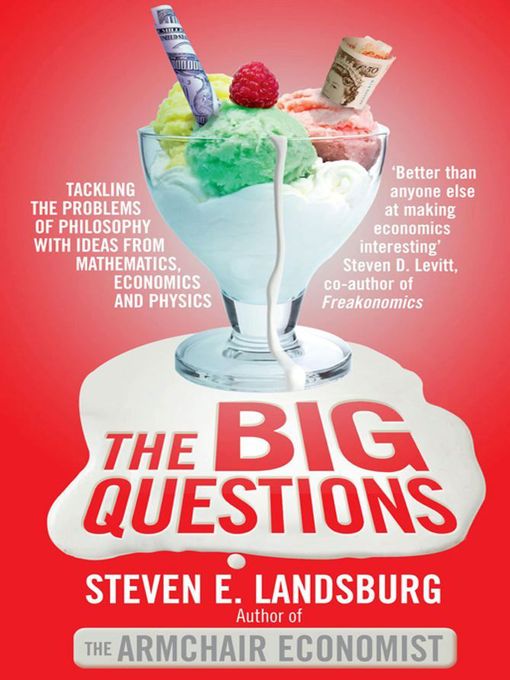
The Big Questions: Book Review

by Viva Avasthi
                                                                       Rating out of 5: ★★★


I don’t know how many of the readers of this blog are familiar with the writings of Steven E. Landsburg, a professor of economics at the University of Rochester in Rochester, New York. For me, this was the first time I’d read any of his books despite the fact that another of his books, entitled ‘The Armchair Economist’, is far more popular.

The book has been written to fulfil the purpose of “tackling the problems of philosophy with ideas from mathematics, economics and physics”, which sounds brilliant, but it’s arguable as to whether the author actually manages to achieve this purpose as well as could be expected from a best-selling author.

In his introduction to the book, Landsburg writes:

“In this book, I’ll tell you what I believe about the nature of reality, the basis of knowledge, and the foundations of ethics. I’m not sure any of my beliefs are right, but I’ll explain why I think they’re plausible – and more likely to be right than any other beliefs. (Though of course I might eventually be convinced otherwise by new arguments.)” 

Sunday, 30 December 2012

2012 in the City

by Viva Avasthi

Now that we've (successfully) come to the end of another year (because the world hasn't ended), here's a useful overview of the major political and economic occurrences this year from The Week magazine.

Note that if you open the images in new tabs, you'll be able to read the text far more clearly.


Wednesday, 12 December 2012

Demand and Supply Analysis to solve Parking Problems?

by Karina Shooter

In many crowded cities across the world it is common for frustrated drivers to be unable to find a parking space. In fact, it has been estimated that about one third of congestion in cites is caused because drivers circle the streets in order to find an empty parking spot. This not only inconveniences the drivers themselves, but also has a big social cost - cars circling the streets produce extra fumes and pollution (which otherwise would not have been produced had a parking space been available) and it also increases the risk of accidents - a driver looking for a parking space is much less likely to notice an oncoming pedestrian or cyclist. 

In order to combat this problem, San Francisco has introduced a high-tech parking system called SFpark. The aim is to keep one parking space free per block at any one time, by using supply and demand analysis. 

Since sensors have been installed into parking bays around the city, which register when the parking bay is being used, drivers now pay flexible parking rates in accordance to how busy the parking spaces on that block are. The rates are reviewed every two months. If a block of parking spaces is particularly popular and rarely has a free parking space, rates for that block can be increased by 25 cents, whereas if a block frequently has free parking spaces, prices can be decreased by up to 50 cents in order to increase demand and reduce the number of available parking spaces until only one per block remains. 

SFpark has also made it easier for people to pay for parking, by introducing credit card machines in parking meters. In addition, people are able to check online, via text or on their smartphones whether the area which they would like to park has any available parking spaces - this may encourage people travelling to busy areas to use public transport. 

Although it is too early to conclude whether the new parking system has been effective, preliminary data suggests that three-quarters of the blocks have either hit their targets or moved closer to the overall goal of one available parking space per block. In addition, the scheme seems to be more successful on weekdays than weekends. 

Saturday, 8 December 2012

Cuts cost Growth

by James Wand


This week's Autumn Statement was possibly the bleakest outlook on the economy for more than sixty years. The economy is in an appalling state of stagnation and collapse, the foundations are failing and plans to secure its recovery are faltering at every turn. George Osborne has failed to heed the warnings from the IMF and the World Bank, and is placing ideology and addiction to public sector cuts before the necessity of supporting the weakest and most vulnerable in our society. This Urgent Statement addresses the horrifying Autumn Statement.

As we further move towards winter we must face the reality that what lies immediately ahead will be the twenty-first century version of the winter of discontent. Osborne, addicted to cuts, deeper cuts, and even deeper cuts admitted today that Plan A had failed and austerity would last until 2018 at the earliest. Average growth forecasts from the Office for Budget Responsibility, the IMF, EU Commission and Credit rating agencies have even suggested that such claims are unrealistic; with comparisons to the March Budget suggesting that confidence even within the inner circle of the Treasury has all but disappeared. We face a decade of decay and austerity – this is no less than a national disaster and one that we must address quickly.

Friday, 7 December 2012

Stem Cell Research: Life-Saving or Cold-Blooded Murder?

by Sparshita Dey

^Embryonic stem cells
Stem cell research may be the next scientific breakthrough. Scientists think that if we can discover how specialised cells turn off/on certain genes to give them particular functions and characteristics, we can start "growing" specific cells using stem cells from a person's body. These can be used to cure genetic diseases (which cannot be cured at the moment and can result in a lifetime of pain and discomfort, including early deaths) as well as other diseases that are not yet curable e.g. diabetes and paralysis. So surely using stem cells should get the go-ahead straight away? Then why do so many people oppose it? 

What is Stem Cell Research and what are Stem Cells?

Stem cell research is to do with the research of undifferentiated cells (i.e. cells with the ability to differentiate/specialise into any type of cell with any type of function in the body depending on where it is needed/ used). In plants, specialised cells can become unspecialised again (like stem cells) and then re-differentiate if needed. However, in animals, like humans, the stem cells differentiate very early on in the development of the organism (from just after a zygote is formed – i.e. in the embryonic stage) and this change is permanent.

Tuesday, 4 December 2012

Academies: The Dangerous Schools

by James Wand

michael gove, secretary of state for education, education secretary, academies
Michael Gove, the UK's Secretary of State for Education
Image courtesy of The Times
After disappointing results for thousands of students in their GCSE exams this summer, those entering secondary schools for the first time this week will be going in with more trepidation than ever before. It’s hard not to feel that the class of 2012 have been hard done by as they bear the brunt of Michael Gove’s radical reforms. Radical reforms that have resulted in schools changing from local education authority lead establishments to academies and free schools, moving away from the safety net that is local government and towards the dangerous and volatile world that is the educational free-market.


Sunday, 18 November 2012

Can footballers’ wages be justified?

by Daniel Hearn


With top footballers’ wages rising massively over the last decade or so, football is the subject of debate as to whether footballers are worth the extravagant salaries they are paid. Many argue that it is not fair that footballers get paid such huge salaries for 'chasing a ball around a pitch for 90 minutes' while nurses, who are of great social value, average a measly (in comparison) £18000-£35000 a year. Initially, it appears that there is cause for debate because footballers like Samuel Eto’o who appear to offer little, if any, social benefit, make more than £35000 in a week! A breakdown of Eto’o’s wages is shown in the image to the right:

His wages do indeed appear excessive, but surely there must be a reason for this. In actual fact, there are a number of reasons that soon shed light on why footballers’ wages so extortionate. 


Tuesday, 30 October 2012

The Rise of Brazil

by Viva Avasthi


1. Why has Brazil experienced such rapid economic growth?


brazil, brazil flag
The graph below (despite its confusing title) shows the real GDP growth of Brazil compared to the US and UK.

To see how Brazil compares to other countries, click the words 'Explore data' on the bottom right of the graph.


Through its combination of a young population, plenty of natural resources and a fairly robust political system, Brazil has managed to create and sustain a boost in its economic state. The rise of China (which will be explored later in the series, but has been already been explained by our author Chris Pearson here) contributed to Brazil's economic development as China had, and still has, a massive demand for commodities due to its sudden surge in manufacturing. (For a simple and effective explanation of what commodities are, click here.) Brazil's massive levels of exports of commodities to China leaves it slightly vulnerable as China's economic condition has a direct impact on Brazil's economy.


During the first decade after the Cold War, America's relations with Brazil drastically declined, which marked the beginning of the end of the US' influence over Latin America. This resulted in Brazil having more independence in its political and economic actions, which allowed it to expand without the somewhat oppressive and exploitative US hindering its progress.


Aside from its commodities exports, Brazil has a fairly well developed high-tech industry. Brazil has clearly made use of the resources it has, but it could be argued that it is overly dependent on exporting commodities. However, notable examples of other areas where Brazil does very well globally are ethanol production and the aviation industry.


Ethanol production

Brazil is the second largest producer of ethanol in the world after the United States. In 2010, Brazil produced 486,000 bbl/d of ethanol, up from 450,000bbl/d in 2009. A combination of high world sugar prices, a poor sugar cane harvest, and underinvestment caused a precipitous decline in ethanol production in 2011.
Source: http://www.eia.gov/cabs/brazil/Full.html, Last Updated: Feb. 28, 2012