Showing posts with label European Union. Show all posts

Wednesday, 21 August 2013

Youth Unemployment in Europe - What are the effects and how can we solve it?

by Karina Shooter

Photo Courtesy of gkardashev.com

In July, Angela Merkel announced that youth unemployment was a priority in the Eurozone. Many people believe that this decision was far overdue - the youth unemployment rate is now at 58.7% in Greece and 56.1% in Spain. But what is the effect of youth unemployment and what can we do to reduce it? 
The first question which needs to be addressed is why youth unemployment is more dangerous than unemployment in general. The main reason for this is that jobs become easier to get the more experience you have - it is important for young people to get on the 'job ladder' quickly, so they can gain experience and progress to better jobs. If youth unemployment is rife, then a generation of young people gain no experience, so even when the economy stabilises and employers are willing to hire workers again, they are too inexperienced to be offered a job - hence they become 'the jobless generation'. This is a massive waste of skills and resources. The second issue which arises from mass youth unemployment is an ageing population. When youth unemployment is high in a particular country, young people tend to move abroad in order to find work. This means that countries such as Spain and Greece, have lots of older retired people in their country but not enough young working people who pay their taxes so the government can support the citizens - this may, at an extreme, result in poorer quality state education which would lead to under qualified youth and may cause a youth unemployment spiral. 

Monday, 15 July 2013

Britain's EU Membership - The Cons

by Karina Shooter

Picture courtesy of studentthinktank.eu
In my previous article, we looked at the advantages of Britain’s EU membership.  Now we are going to consider the alternative point of view – what are the disadvantages?

One of the most common arguments which is used to oppose Britain’s EU membership is the cost. Different estimates on how much EU membership costs Britain per year vary dramatically, for example although the Foreign Office and Commonwealth say that the cost of EU membership is £300 per head, the Bruges (an anti EU group) claim that the cost per head is £873. The argument put forward from Euro sceptics is that we are suffering from an imbalance of payments – the UKs allocation from the EU budget is much less than our contribution in the form of membership payments – therefore we are experiencing a trade deficit.


Thursday, 4 July 2013

Britain’s Membership of the EU – The Pros

by Karina Shooter

Photo courtesy of www.bbc.co.uk

Sky News has announced the results of an exclusive survey about Britain’s EU membership. In response to the question: "Do you think that the United Kingdom should remain a member of the European Union?” 51% voted ‘No’, with 49% supporting the ‘Yes’ option.

The results show that there is no clear consensus on people’s views towards EU membership, and if we take into account the fact that the poll will have a margin of error, it really does highlight how result of the referendum vote could go either way. This means that it is more important than ever to discuss the pros and cons of EU membership. I will look at each side of the argument in separate articles. In this article we will look at the advantages of Britain being a member of the EU, in a subsequent article I will explore the disadvantages. 

Perhaps the most obvious advantage of EU membership is the single market. Europe is the world’s largest single market – it is an economic zone larger than that of the USA and Japan combined and it has a total GDP of around £11 trillion. The single market allows Britain to freely trade good and services between countries in the European Union, without tax or regulations. European markets account for half of the UK’s overall trade and foreign investments. It is said that EU countries currently trade twice as much with each other as they would do in the absence of the Single Market. 


Saturday, 8 September 2012

End of the Eurozone Crisis?

by Karina Shooter

An announcement has been made by Mario Draghi, the President of the European Central Bank, which could potentially mark a major turning point in the Eurozone crisis. Draghi announced that the European Central Bank (ECB) promises to provide unlimited support to troubled Eurozone countries such as Spain and Italy.

Mario Draghi, Eurozone, European Union, economics for teens, economics for teenagers
Mario Draghi  Photograph by Mario Vedder/dapd/AP Photo
Draghi's plan is to remove the limit on the number of bonds that the ECB can buy from governments in troubled countries, which would cut those countries' borrowing costs. However there is a catch - Nations would first have to request help from the ECB as well as accept new conditions including an austerity clause. This may cause problems for countries such as Spain, where riots continue at the prospect of a bailout.

Although markets soared when the announcement was made, critics from the German Central Bank say that Draghi's plan is not a long term solution and is just propping up governments.

The announcement has taken away some major question marks about who's responsibility it is to support the Euro when it is under pressure. Governments have failed at this task, and it is now the ECB's turn to see if they can offer the protection and insurance that the Euro badly needs.

Following this announcemnt, one thing is for certain, I definitely won't be making any bets that the PIIGS (Portugual, Ireland, Italy, Greece and Spain) will default on their debts or bail out of the Euro any time soon.

Sunday, 20 May 2012

So What Next For The Euro?

by Hannah Gent

In my last article I described how the desire of European nations after World War II to prevent future conflicts led to increasing co-operation and integration with the ultimate formation of the European Union and the single European currency.  I looked at how, despite this having significant benefits, the ‘one size fits all’ policy was risky, tying nations at different stages of economic cycles to a fixed interest rate that could either prevent growth or over-stimulate economies.  The financial crisis of the last four years has exposed the weaknesses in this system and the next three months are going to be very interesting indeed.  So what is going to happen next?

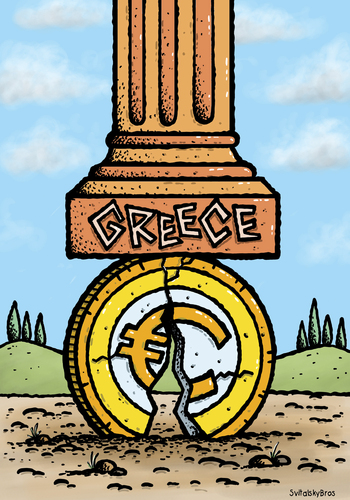
greece, euro, eurozone crisis, world, europe, economy

Sunday, 6 May 2012

The Euro Crisis - How Did We Get To Where We Are?

by Hannah Gent


european union, EU, flag, economics for teens, economics for teenagersEuropean Union, EU, flag, economics for teens, economics for teenagers


The world is in the middle of very turbulent financial times, particularly in Europe. In the first of two articles I will explain how the current situation has arisen.

In 1958, six European countries decided to join together for their mutual benefit. It was soon after the Second World War and it was thought that future conflicts could be avoided by greater cooperation. This was the beginning of the European Union (EU) although it was not known by this name until 1993. There are now 27 member states mainly within Europe.